Ph.D. in Physics, POSTECH, South KOREA Mar. 2011 - Feb. 2017
B.S. in Physics POSTECH, South KOREA Mar. 2007 - Feb. 2011
CONTACT INFO
📧 gha@niu.edu
ABOUT ME
Experimental accelerator physicist specializing in beam phase space manipulation, wakefield acceleration, and diagnostics development.
Experienced in developing new manipulation methods and diagnostics tools, covering the full experiment cycle from design to data analysis.
Strong research focus on 6D phase space control and its applications.
Early-career educator, serving as the primary supervisor of 4-6 graduate students.
Dedicated to providing students with valuable research opportunities and introducing them to outstanding scientists, following the example of my own mentors.
WORK EXPERIENCE
Assistant Professor of Physics (Aug. 2023 - Present)
Department of Physics, Northern Illinois University
Leading experiment / Accelerator operator / Laser optics / Vacuum work / Lattice design / Diagnostics design
Emittance-exchange / Structure wakefield (high efficiency) / Medical accelerator
Research Aide Graduate Student (Jun. 2012 - Apr. 2016)
High Energy Physics, Argonne National Laboratory
Leading experiment / Accelerator operator / Laser optics / Vacuum work / Lattice design / Diagnostics design
Injector optimization
Emittance-exchange / High-gradient structure wakefield / Ultrafast electron microscopy
HONORS AND AWARDS
DOE Early Career Award 2025-2030
Enrico Fermi Named Fellowship 2018 - 2021
Distinguished performance award, 8th International Accelerator School for Linear Colliders 2013
Outstanding T. A., Department of Physics, POSTECH 2013
Outstanding T. A., Department of Physics, POSTECH 2011
National Scholarship for Science and Engineering 2007 - 2011
RESEARCH VISION AND INTERESTS
“6D phase space by design: designing ideal 6D phase spaces for various accelerator applications and developing manipulation methods to realize designed 6D phase spaces”
Beam physics with particular focus on phase space manipulation
Experimental researches of advanced accelerator concepts
High brightness injector development
Physics of accelerator-based THz / X-ray radiations
Medical and industrial applications of compact accelerators
RESEARCH ACTIVITIES
*Items below show highlighted research directions and associated R&D.
Beam Physics
Longitudinal bunch shaping
Arbitrary profile shaping using emittance-exchange (EEX)
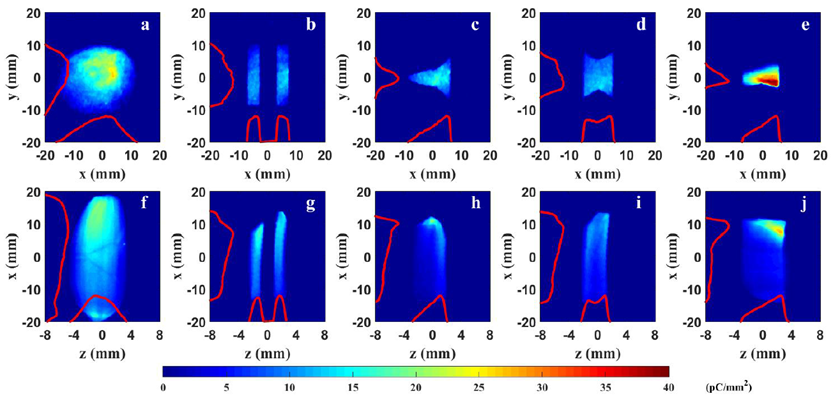
EEX beamline provides an exchange of transverse and longitudinal phase spaces. Due to the exchange, any characteristics that transverse phase space has become longitudinal properties. This unique feature of the EEX beamline can be used to shape the longitudinal profile. The capability of arbitrary longitudinal profile shaping was demonstrated using an EEX beamline. Several different masks were used to shape beam’s horizontal profiles. Then, the beam was sent to an EEX beamline for the exchange. The final longitudinal profiles were measured using a deflecting cavity.
Fig. 1: Longitudinal bunch shaping using an EEX beamline with transverse masks. Several different masks were applied to the beam to shape its transverse profile. The beam was sent to the EEX beamline after the transverse shaping. The top row shows the beam’s x-y image before the EEX beamline, and the bottom row shows the beam’s z-x image after the EEX beamline. From G. Ha et al., Phys. Rev. Lett. 118, 104801 (2017).
CSR-free shaping using transverse deflecting cavities
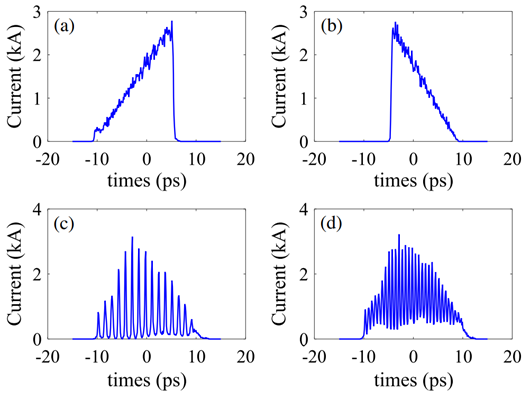
One of the critical limitations of existing shaping methods is collective effects, such as CSR and space-charge force. One possible way to avoid the collective effect is shaping a high-energy beam without dispersive elements. This can be accomplished by several deflecting cavities with a mask. The first deflecting cavity introduces a correlation between t and x. The mask shapes the beam at the place where the time dominantly determines the horizontal distribution. The downstream beamline should be designed to eliminate the remaining correlation. This can be achieved in various ways, such as a quadrupole and a deflecting cavity. The work was demonstrated in the simulation so far. The simulation showed high-precision shaping of 60 nC bunch.
Fig. 2: Deflecting-cavity-based longitudinal shaping. A beamline that consists of two deflecting cavities with a quadrupole in the middle was used for the start-to-end simulation. 60-nC beam was generated and shaped by various masks. (a) shows doorstep profile that has remained charge of 22 nC, (b) shows reversed triangle profile that has remained charge of 18 nC, (c) shows THz-bunch-train that has charge of 12 nC, and (d) shows THz-bunch train (a higher frequency) that has charge of 23 nC (~1 nC per bunch). From G. Ha et al., Phys. Rev. Accel. Beams 23, 072803 (2020).
Lossless arbitrary shaping using transverse wigglers
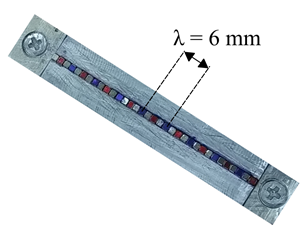
Arbitrary curves can be approximated by the Fourier series. In other words, any correlation on the phase space can be decomposed to the summation of multiple cosine correlations on the phase space. One of the ways to apply these cosine correlations is using a small magnet array that I call as transverse wiggler, which is a tiny wiggler that is rotated by 90 degrees.
Fig. 3: Picture of transverse wiggler used for bunch train generation experiment. Pair of the magnet arrays form a single transverse wiggler. The magnet array is linear Halbach array with 1.5-mm cube magnets.
This wiggler can provide an on-axis magnetic field of
By≈B0cos(λw2πx)exp(−λwπg),
which includes the cosine term. Also, the field strength is controllable by the gap (g). This method can be used to generate arbitrary shaping because certain correlations followed by proper R12 can change the original beam’s profile to the target profile. The required correlation can be found from
where Nf(x) is the final profile, N0(x) is the initial profile, x0 is the initial horizontal coordinate, Rij is (i, j) element of the transfer matrix for following optics, and f(x) is the correlation function. The scheme was only numerically demonstrated yet.
High brightness source
Capillary Trojan horse
Capillary Trojan horse is the concept proposed to avoid complicated system and timing setup difficulty of Trojan horse method that uses Laser Plasma Wakefield. In the capillary version, a sub-THz structure is used as a gun cavity, and it is powered by the wakefield from a drive bunch train that passes through the structure. Xenon gas fills out the structure for a short time (~a few microseconds), and focused UV laser generates micro-plasma that includes electrons that will be accelerated by the wakefield. The experiment was carried out, but couldn’t demonstrate the scheme due to drive bunch transmission issue. This experiment will be revisited in the near future with an improved AWA drive gun.
High-gradient X-band gun powered by two-beam acceleration (TBA)
One of the attractive approaches to achieve a high brightness beam is increasing the acceleration gradient in the gun. However, the increase of the gradient also introduces a strong field emission from the cathode. This was the main reason that most modern RF photocathode guns choose 100 MV/m or lower as their operating gradient. The new scheme was proposed to use TBA to power the X-band gun so that the gun gradient can reach 400 MV/m, and significantly suppress the dark current due to TBA’s short pulse length (~10 ns full width). Recently, this scheme was demonstrated experimentally. The main beam energy of ~3.4 MeV was achieved, and this corresponds to >300 MV/m. Also, dark currents were not detected in the range that the diagnostics setup allows. Here, the diagnostics include YAG screen, Faraday cup, and current transformer.
Electron cooling
Modulation boosting using a wiggler
A beam passing through a wiggler can be considered as a beam with lower energy (γz=γ/(1+K2/2) drifts for the same distance without any other fields than the space-charge field. This fact tells us that we can apply a stronger space-charge force or similar kind to the beam by introducing a wiggler to the beamline. The microbunched-electron-cooling scheme is a possible beneficiary of this phenomenon. One of the microbunched-electron-cooling scheme’s issues is long drift spaces in-between chicanes to convert density modulations from chicanes to momentum modulations, which is required for modulation amplification in the following sections. Adding a wiggler to the drift area can boost the modulation conversion and may significantly reduce the required space. The concept still has lots of items to be proven by theory and experiment. The proof-of-principle experiment to see wiggler’s reduced gamma effect confirmed its existence and reasonable matches with simulations. The next step would be the proof-of-principle experiment for modulation conversion boosting.
CSR effect mitigation
CSR shielding effect in EEX
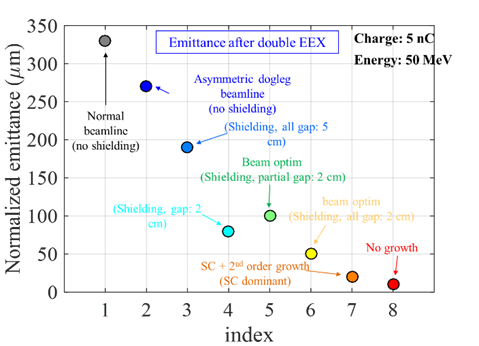
Transport of a high charge beam (5-10 nC) through an EEX beamline is one of the attractive methods to provide shaped drive bunch for collinear wakefield acceleration or intense radiation sources. Such a high charge generates intense CSR along the path, and the simulation estimated ~3000% emittance growth when there is no treatment. While the optical methods are still options to consider, shielding is one of the interesting options because it can reduce the amplitude of CSR wake. The simulation showed a significant improvement of emittance when the shielding is introduced. When the optics was optimized with a small-gap shielding (2 mm), the growth went down to ~500% (see Fig. 5). This is a dramatic change for 5 nC beam passing through eight dipole magnets having 20 degrees of bending. To experimentally investigate its impact on the EEX beamline and the emittance growth, dipole chambers with tunable gap were installed at the AWA facility. This work still requires further experiment study along with algorithm development for proper shielding simulations.
Fig. 5: Summary of method and result for CSR-induced emittance growth suppression. AWA’s EEX beamline is assumed for the simulation. 5 nC and 50 MeV beam was used to simulate the growth. From G. Ha et al., in Proc. of FEL17, TUP054 (2017))
2D correlation control
Arbitrary correlation generation using transverse wigglers or high-frequency structures
As described earlier, transverse wigglers can provide cosine-correlation on the transverse phase space. Thus, the series of transverse wigglers, which is short in Z-direction, may be able to generate arbitrary correlation on the transverse phase space. Similarly, high-frequency structures powered by the target bunch or a separate drive bunch can also introduce cosine-correlation on the longitudinal phase space. Currently, researches on its first application, arbitrary profile generation, is under-way.
Diagnostics
Single-shot wakefield measurement
Longitudinal phase space can be measured by using a deflecting cavity and a dipole magnet with a slit in front of them. This well-known measurement technique can be used to measure the longitudinal wakefield by introducing a trailing long witness bunch. If the long witness bunch’s charge is low, the wake that a drive bunch excites dominantly determines the energy change on the witness bunch. Then the longitudinal phase space measurement of the witness bunch provides the information of the wakefield. This was experimentally demonstrated and used to measure the transformer ratio of triangular shape bunch.
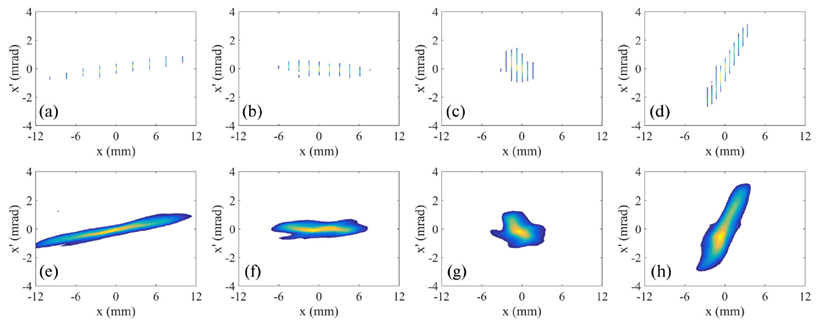
Single-shot transverse phase space measurement
During the longitudinal phase space measurement, a deflecting cavity projects the time coordinate to one of x or y coordinates, and a dipole magnet projects the energy coordinate to the remaining coordinates. A similar projection can happen on the transverse direction for either (x,x’) or (y,y’) by using a skew quadrupole followed by a normal quadrupole. The skew quadrupole introduces a correlation between x and y’, and the correlation makes another correlation between x and y as the beam drifts. While x and y build up the correlation along the drift, x’ also affects the x. At this point, all necessary correlations are achieved. Thus, following normal quadrupole is set to eliminate most of remaining correlations. Similar to the longitudinal phase space case, this configuration introduces extra correlation that cannot be eliminated, so a slit should be located in front of the skew quad to minimize the extra correlation terms. The concept was demonstrated by experiment for a single slit, and its possible application to single-shot slice-phase space measurement was also explored by simulation.
Fig. 4: Single-shot transverse phase space measurement. The first and the second rows correspond to slit-scan measurement and projection measurement, respectively. Each column corresponds to different upstream quadrupole settings. The slit-scan has ten data points, and 100-images were taken at each point. This takes total 500 seconds to finish the measurement. On the other hand, the projection method provides the phase space image of each shot. Displayed images are one of 50 images taken during the experiment. From G. Ha et al., Phys. Rev. Accel. Beams 24, 012802 (2021).
Ultra-high-resolution longitudinal measurement using EEX
Similar to shaping-based on correlation, measurements based on the correlation has its limitation. However, in principle, transverse measurement after the exchange can be considered a direct longitudinal measurement, and its resolution will be limited by other equipment such as a camera. By adding a quadrupole downstream of the EEX beamline and applying certain currents, it is possible to generate and switch a linear correlation between the final horizontal position of particles (xf) and their initial longitudinal position (zi) or energy spread (δi). Numerical estimation showed possibilities of a few attosecond resolution for time and a sub-keV resolution for energy (for 2 GeV beam). The work still requires lots of simulation and experimental demonstration.
Advanced Accelerator Concepts
High transformer ratio
Highest transformer ratio in wakefield accelerations (SWFA) (R~5, 7)
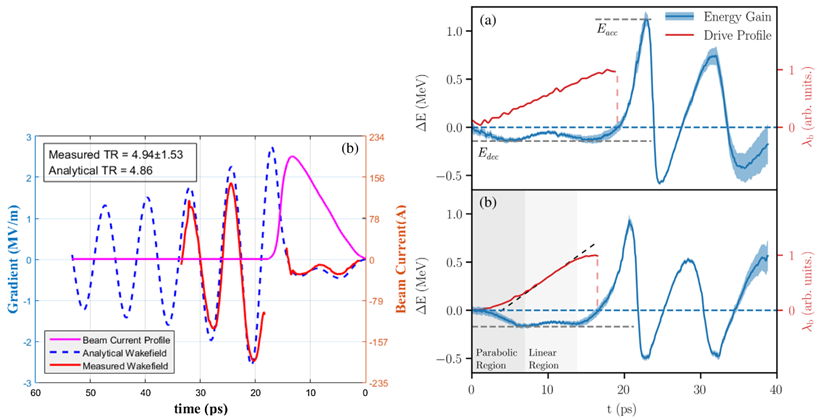
The world’s highest transformer ratio in SWFA was demonstrated by using a triangular bunch and a dielectric-slab structure. The triangular bunch was generated by an EEX beamline at the AWA facility. The slab structure had a gap of 2.1 mm and provided ~2 MV/m of acceleration gradient. From the single-shot longitudinal wakefield measurement, both accelerating and decelerating fields were measured, and it provided a transformer ratio of 4.65. See measurement result and comparison with analytically expected wakefield in Fig. 6.
Similarly, the world’s highest transformer ratio in PWFA was demonstrated by using a triangular bunch. The same experimental setup was used for the demonstration. Here, the transformer ratio of 7.8 was achieved. See measurement result for wakefield and reconstructed current profile in Fig. 6.
Fig. 6: World highest transformer ratios. The left column corresponds to the measurement from SWFA experiment, and the right column corresponds to the measurement from PWFA experiment. From Q. Gao et al., Phys. Rev. Lett. 120, 114801 (2018) and R. Roussel et al., Phys. Rev. Lett. 124, 044802 (2020).
Two-beam acceleration
High power generation from 11.7 GHz metallic structure and the first demonstration of TBA-staging in short-pulse regime
The high gradient acceleration of the witness bunch by TBA was demonstrated. Also, the staging of two-beam wakefield acceleration was demonstrated, which was the first experimental demonstration of the staging of TBA. Two metallic X-band power-extraction and acceleration structures were prepared. In the case of single structure acceleration, the experiment demonstrated 150 MV/m gradient, and two-stage staging was demonstrated with 70 MV/m gradient. The energy gain from each stage was about 2.4 MeV.
Structure R&D support
Participation of various structures’ development and high-power tests
THz-bunch train generation using transverse wiggler and EEX
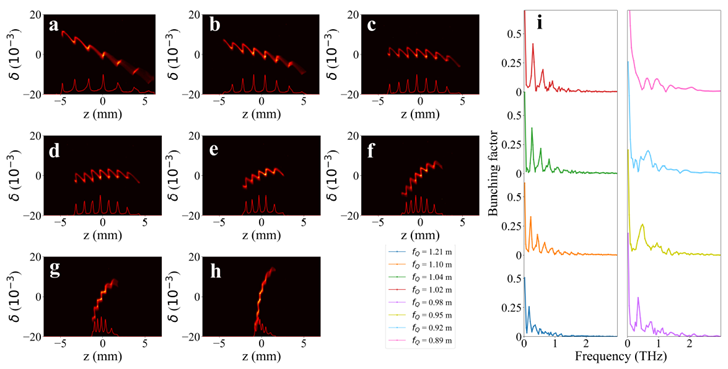
Because the transverse wiggler introduces cosine correlations, the beam will be transversely bunched if the beam modulated beam drifts. This transverse density modulation can be easily converted to a longitudinal density modulation (i.e., bunch train) by EEX. A transverse wiggler with 6-mm wavelength was used to demonstrate tunable THz bunch train generation. In this scheme, the bunch-to-bunch spacing is determined by the original wiggler wavelength and the compression that the EEX beamline provides. The bunching factor can be easily maximized by controlling the gap size of the wiggler because it controls the modulation amplitude. We demonstrated frequency control from 0.16 THz to 0.8 THz by a single quadrupole control. For each case, the bunching factor was optimized by controlling the gap.
Fig. 7: Tunable THz bunch train generation. The longitudinal phase space of the bunch after the EEX is displayed on the left. The corresponding frequency spectrum of the beam is shown on the right. Each case corresponds to a different focal length of the quadrupole in front of the EEX.
Deflecting-cavity-based shaping for high charge bunch train for THz-SWFA
As shown in Fig. 2, deflecting-cavity-based shaping may generate a high-charge bunch train. This method may be a new opportunity to explore a high-gradient acceleration in a new regime (e.g., THz two-beam acceleration). Analytical estimation of the THz two-beam acceleration with a high-charge bunch train (8×1.0 nC) showed an accelerating gradient of 4 GV/m with a 1.4 THz structure.
THz bunch train generation using micro-lens array
A micro-lens array (MLA) can generate an array of UV laser dots because each micro-lens can focus the small portion of the UV laser that enters into each micro-lens. This sub-mm to mm dot array can generate sub-mm to mm electron beam array. The electron beam array can be imaged to the entrance of an EEX beamline for transverse-to-longitudinal conversion. Here, the modulation frequency corresponds to THz, and it can be tuned by rotating the MLA. The work was experimentally demonstrated at the AWA facility.
Extremely low energy spread
Bunch compression using double EEX and nonlinear magnet to control time-energy correlation
Double EEX beamline consists of two EEX beamlines and a transverse manipulation area in-between. To avoid using a large original longitudinal emittance as transverse emittance at the end, two EEX beamlines exchange the phase space two times while the middle section provides easy control for the longitudinal phase space. In this concept, the bunch compression can be accomplished by controlling a quadrupole in the middle, and any nonlinear correlation on the initial longitudinal phase space can be adjusted by any nonlinear magnets. The bunch compression using a double EEX beamline was experimentally demonstrated. Also, nonlinear correction capability was demonstrated by using an octupole magnet installed in the middle area. This double EEX bunch compressor may enable to operate all linac on-crest and elimination of higher-order-cavities for linearization. Simulation using a double EEX beamline with LCLC-II lattice provided 2E-5 without harmonic cavities.
Multi-color radiation
Double EEX with wakefield modulator to generate time-controlled spectral bunch train
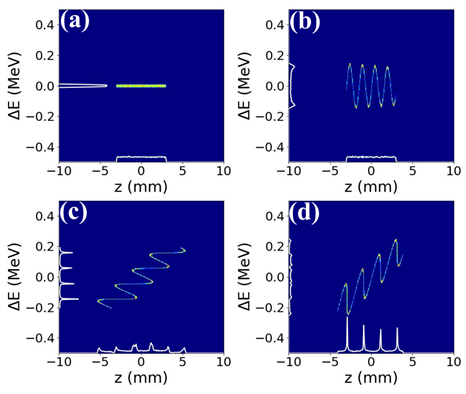
As the quadrupole in-between two EEX beamlines provided the compression, a series of quadrupole magnets can provide control of R51, R52, R61, R62. This control introduces an interesting manipulation option with modulation. If a structure is located in front of a double EEX beamline, the energy modulation that the structure introduced can be controlled by quadrupole magnets in the middle of the beamline. It can be either converted to a longitudinal density modulation as the panel (d) of Fig. 8 or a spectral density modulation as shown in the panel (c). These density modulations can be used for pump-probe or two/multi-color radiations.
Fig. 8: Modulation control using double EEX. Plots show simulated longitudinal phase space at several different locations. (a) is the phase space before a structure, (b) is the phase space after the structure. (c) and (d) show phase spaces after a double EEX beamline. Quadrupole magnets in the middle were adjusted to achieve density modulations on energy (c) and time (d). From J. Seok et al., arXiv: 2104.07296 (2021).
Medical/Industrial Applications
Klystron development
High-efficiency S-band klystron
Spacing between cavities and cavity frequencies were optimized to enhance S-band klystron’s efficiency (typical: ~40%). The 3D simulation by CST showed 56% efficiency after the optimization. This work was co-work with a company in KOREA to make their new klystron products.
A tridactyl beam transport line was designed to deliver proton beams accelerated by RFQ to the neutron conversion target for each treatment room. The beamline included double-bend achromat and beam expander. This work was co-work with a company in KOREA to make ABNCT facility as their commercial product. The project included development of proton source, RFQ, beam transport, target system, treatment planning system, medicine, radiation safety, etc.
TEACHING VISION AND INTERESTS
“Provide environment, knowledge, experience, opportunities, and network to help students’ self-motivation and understanding”
Individual or small group discussion regarding students’ goal
Alec Tilton, NIU, Master program (2025-) Thesis topic: Measurement of CSR shielding effect on beam under realistic compression environment
Minkyu Seo, Korea University, Master program (2024-) Thesis topic: Emittance exchange-based ultrahigh resolution longitudinal diagnostics development
Alex Desimone, NIU, Master program (2024-) Thesis topic: Deflecting cavity-based longituidnal manipulation
Spencer Kelham, NIU, PhD program (2024-) Thesis topic: Development of phase-diversity electro-optic sampling method
Deeksha Sinha, NIU, PhD program (2024-) Thesis topic: Higher order modes in RF structures - Analysis and applications
Buse Naz Temizel Ozdemir, NIU, PhD program (2024-) Thesis topic: Longitudinally nano-scale modulation generation for next generation compact radiation source
Jimin Seok, UNIST, PhD program (2017 - 2021) Thesis topic: Beam manipulation using double emittance-exchange beamline Currently post-doctoral appointee of Pohang Accelerator Laboratory
Thesis Support
Tianzhe Xu, Northern Illinois University, PhD program (2018-2021)
Gongxiaohui Chen, Illinois Institute of Technology, PhD program (2018-2020)
Maomao Peng, Tsinghua university, PhD program (2018-2019)
Nathan Xin Nie, University of Chicago, MS program (2018)
Aliaksei Halavanau, Northern Illinois University, PhD program (2015-2017)
Qiang Gao, Tsinghua university, PhD program (2015-2017)
Nicole Nevau, Illinois Institute of Technology, PhD program (2014-2018)
Jiahang Shao, Tsinghua university, PhD program (2014-2016)
Dan Wang, Tsinghua university, PhD program (2014-2016)
Teaching/Mentoring
AWA Intern Advisor Emmanuel Aneke, 2021
Summer Internship Program Tamara Gonzalez Acevedo, University of Puerto Rico, 2019
Teaching Assistant Physics Experiment III class, POSTECH, 2012 Physics Experiment I class, POSTECH, 2011 Physics Experiment II class, POSTECH, 2011
PUBLICATIONS
Peer-reviewed publications
G. Ha, “Development of a Method for Tailoring Arbitrary Two-Dimensional Phase-Space Correlations and Their Applications”, in-preparation.
G. Ha, D. Doran, W. Liu, J. Power, J. Shao, E. Wisniewski, and N. Majernik, “Tunable electron bunch train produced by transverse wiggler and phase space exchange”, in-preparation.
G. Ha, G. Andonian, B. Carlsten, A. Halavanau, N. Majernik, A. Parrack, J. Power, J. Rosenzweig, and M. Yadav, “Coherent radiation from initially modulated beams using emittance exchange at the Argonne Wakefield Accelerator”, Nucl. Instrum. and Methods Phys. Res., Sect. A 1075, 170387 (2025).
B. Leung, A. Ody, C. Phillips, C. Whiteford, D. Mihalcea, E. Wisniewski, G. Chen, G. Ha, O. Rmanchandran, J. Power, P. Piot, S. Doran, W. Liu, and X. Lu, “Experimental design of a W-band corrugated waveguide for wakefield accelerations studies”, Nucl. Instrum. and Methods Phys. Res., Sect. A 1077, 170549 (2025).
G. Ha, “Recent developments in phase space correlation control for charged-particle beams toward achieving arbitrary correlations”, AAPPS Bulletin 25, 7 (2025).
W. Lynn, T. Xu, G. Andonian, D. Doran, G. Ha, N. Majernik, P. Piot, J. Power, J. Rosenzweig, C. Whiteford, and E. Wisniewski, “Observation of skewed electromagnetic wakefields in an asymmetric structure driven by flat electron bunches”, Phys. Rev. Lett. 132, 165001 (2024).
G. Andonian, N. Burger, N. Cook, S. Doran, T. Hodgetts, S. Kim, G. Ha, W. Liu, W. Lynn, N. Majernik, J. Power, A. Pronikov, J. Rosezweig, and E. Wisniewski, “Drive bunch train for the dielectric Trojan horse experiment at the Argonne Wakefield Accelerator”, Instruments 8, 28 (2024).
H. Kong, M. Chung, D. S. Doran, G. Ha, S.-H. Kim, J.-J. Kim, W. Liu, X. Lu, J. Power, J.-M. Seok, S. Shin, J. Shao, C. Whiteford, and E. Wisniewski, “Fabrication of THz corrugated wakefield structure and its high power test”, Sci. Rep. 13, 3207 (2023).
J. Seok, G. Ha, J. Power, M. Conde, E. Wisniewski, W. Liu, S. Doran, C. Whiteford, and M. Chung, “Experimental demonstration of double emittance exchange toward arbitrary longitudinal beam phase space manipulations”, Phys. Rev. Lett. 129, 224801 (2022).
W. H. Tan, S. Antipov, D. S. Doran, G. Ha, C. Jing, E. Knight, S. Kuzikov, W. Liu, X. Lu, P. Piot, J. G. Power, J. Shao, C. Whiteford, and E. E. Wisniewski, “Demonstration of sub-GV/m accelerating field in photoemission electron gun powered by nanosecond X-band radio-frequency pulses”, Phys. Rev. Accel. Beams 25, 083402 (2022).
A. Alba, J. Seok, A. Adelmann, S. Doran, G. Ha, S. Lee, Y. Piao, J. Power, M. Qian, E. Wisniewski, J. Xu, and A. Zholents, “Benchmarking collective effects of electron interactions in a wiggler with OPAL-FEL”, Comput. Phys. Commun. 280, 108475 (2022).
G, Ha, K.-J. Kim, P. Piot, J. G. Power, and Y. Sun, “Bunch shaping in electron linear accelerators”, Rev. Mod. Phys. 94, 025006 (2022).
F. Lemery, G. Andonian, S. Doebert, G. Ha, X. Lu, J. Power, and E. Wisniewski, “Drive beam sources and longitudinal shaping techniques for beam driven accelerators”, J. Instrum. 17, P05036 (2022).
J. Picard, I. Mastovsky, M. A. Shapiro, R. J. Temkin, X. Lu, M. Conde, D. S. Doran, G. Ha, J. Power, J. Shao, E. E. Wisniewski, and C. Jing, “Generation of 565 MW of X-band power using a metamaterial power extractor for structure-based wakefield acceleration”, Phys. Rev. Accel. Beams 25, 051301 (2022).
C. Jing and G. Ha, “Roadmap for structure-based wakefield accelerator (SWFA) R&D and its challenges in beam dynamics”, J. Instrum. 17, T05007 (2022).
G. Ha, J. G. Power, E. Wisniewski, W. Liu, and M. Conde, “Single-shot measurement of transverse second moments using projection method”, Phys. Rev. Accel. Beams 24, 012802 (2021).
G. Chen, L. Spentzouris, C. Jing, M. Conde, G. Ha, W. Liu, J. Power, E. Wisniewski, A. V. Sumant, S. Antipov, E. Gomez, K. K. Kovi, and J. Shao, “Demonstration of nitrogen-incorporated ultrananocrystalline diamond photocathodes in a RF gun environment”, Appl. Phys. Lett. 117, 171903 (2020).
G. Ha, J. G. Power, J. Shao, and C. Jing, “Coherent synchrotron radiation free longitudinal bunch shaping using transverse deflecting cavities”, Phys. Rev. Accel. Beams 23, 072803 (2020).
X. Lu, J. F. Picard, M. A. Shapiro, I. Mastovsky, R. J. Temkin, M. Conde, J. G. Power, J. Shao, E. Wisniewski, M. Peng, G. Ha, J. Seok, S. Doran, and C. Jing, “Coherent high-power RF wakefield generation by electron bunch trains in a metamaterial structure”, Appl. Phys. Lett. 116, 26 (2020).
R. Roussel, G. Andonian, W. Lynn, K. Sanwalka, R. Robles, C. Hansel, A. Deng, G. Lawler, J. B. Rosenzweig, G. Ha, J. Seok, J. G. Power, M. Conde, E. Wisniewski, D. S. Doran, and C. E. Whiteford, “Single shot characterization of high transformer ratio wakefields in nonlinear plasma acceleration”, Phys. Rev. Lett. 124, 044802 (2020).
J. Shao, C. Jing, E. Wisniewski, G. Ha, M. Conde, W. Liu, J. Power, and L. Zheng, “Development and high-power testing of an X-band dielectric-loaded power extractor”, Phys. Rev. Accel. Beams 23, 011301 (2020).
H. Andrews, K. Nichols, D. Kim, E. I. Simakov, S. Antipov, G. Chen, M. Conde, D. Doran, G. Ha, W. Liu, J. Power, J. Shao, and E. Wisniewski, “Shaped beams from diamond field emitter array cathodes”, IEEE Transactions on Plasma science, doi: 10.1109/TPS.2020.2984156.
K. E. Nichols, H. L. Andrews, D. Kim, E. I. Simakov, M. Conde, D. S. Doran, G. Ha, W. Liu, J. G. Power, J. Shao, C. Whiteforde, E. E. Wisniewski, S. P. Antipov, and G. Chen, “Demonstration of transport of a patterned electron beam produced by diamond pyramid cathode in an rf gun”, Appl. Phys. Lett. 116, 023502 (2020).
A. Halavanau, Q. Gao, M. Conde, G. Ha, P. Piot, J. G. Power, and E. Wisniewski, “Tailoring of an electron-bunch current distribution via space-to-time mapping of a transversely shaped, photoemission-laser pulse”, Phys. Rev. Accel. Beams 22, 114401 (2019).
Q. Gao, J. Shi, H. Chen, G. Ha, J. G. Power, M. Conde, and W. Gai, “Single-shot wakefield measurement system”, Phys. Rev. Accel. Beams 21, 062801 (2018).
C. Jing, S. Antipov, M. Conde, W. Gai, G. Ha, W. Liu, N. Neveu, J. G. Power, J. Qiu, J. Shi, D. Wang, and E. Wisniewski, “Electron acceleration through two successive electron beam driven wakefield acceleration stages”, Nucl. Instrum. and Methods Phys. Res., Sect. A 898, 72 (2018).
R. Roussel, G. Andonian, M. Conde, A. Deng, G. Ha, J. Hansel, G. Lawler, W. Lynn, J. Power, R. Robles, K. Sanwalka, J. Rosenzweig, “Measurement of transformer ratio from ramped beams in the blowout regime”, Nucl. Instrum. and Methods Phys. Res., Sect. A , (2018).
Q. Gao, G. Ha, C. Jing, S. P. Antipov, J. G. Power, M. Conde, W. Gai, H. Chen, J. Shi, E. E. Wisniewski, D. S. Doran, W. Liu, C. E. Whiteford, A. Zholents, P. Piot, and S. S. Baturin, “Observation of high transformer ratio of shaped bunch generated by emittance-exchange beam line”, Phys. Rev. Lett.120, 114801 (2018).
A. Halavanau, G. Qiang, G. Ha, E. Wisniewski, P. Piot, J. G. Power, and W. Gai, “Spatial control of photoemitted electron beams using a micro-lens-array transverse-shaping technique”, Phys. Rev. Accel. Beams 20, 103404 (2017).
G. Ha, J. G. Power, M. Conde, D. S. Doran, W. Gai, “Limiting effects in double EEX beamline”, Journal of Physics: Conference Series 874, 012061 (2017).
G. Ha, J. G. Power, M. Conde, D. S. Doran, W. Gai, “Simultaneous generation of drive and witness beam for collinear wakefield acceleration”, Journal of Physics: Conference Series 874, 012027 (2017).
G. Ha, M. H. Cho, W. Namkung, J. G. Power, D. S. Doran, E. E. Wisniewski, M. Conde, W. Gai, W. Liu, C. Whiteford, Q. Gao, K. –J. Kim, A. Zholents, Y. –E Sun, C. Jing, and P. Piot, “Precision control of the longitudinal electron bunch shape using emittance exchange beamline”, Phys. Rev. Lett. 118, 104801 (2017).
G. Ha, M. H. Cho, W. Gai, K. –J. Kim, W. Namkung, and J. G. Power, “Perturbation-minimized triangular bunch for high-transformer ratio using a double dogleg emittance exchange beam line”, Phys. Rev. Accel. Beams 19, 121301 (2016).
J. Shao, J. Shi, S. Antipov, S. Baryshev, H. Chen, M. Conde, W. Gai, G. Ha, C. Jing, F. Wang, E. Wisniewski, “In Situ observation of dark current emission in a ghigh gradient rf photocathode gun”, Phys. Rev. Lett. 117, 084801 (2016).
D. Wang, S. Antipov, C. Jing, J. G. Power, M. Conde, E. Wisniewski, W. Liu, J. Qiu, G. Ha, V. Dolgashev, C. Tang, and W. Gai, “Interaction of an ultrarelativistic electron bunch train with a W-band accelerating structure: High power and high gradient”, Phys. Rev. Lett. 116, 054801 (2016).
Evegenya I. Simakov, Sergey A. Arsenyev, Cynthia E. Buechler, Randall L. Edwards, William P. Romero, Manoel Conde, Gwanghui Ha, John G. Power, Eric E. Wisniewski, and Chunguang Jing, “Observation of wakefield suppression in a photonic-band-gap accelerator structure”, Phys. Rev. Lett. 116, 064801 (2016).
Jiaqi Qiu, Gwanghui Ha, Chunguang Jing, Sergey V. Baryshev, Bryan W. Reed, June W. Lau, and Yimei Zhu, “GHz laser-free time-resolved transmission electron microscopy: A stroboscopic high-duty-cycle method”, Ultramicroscopy, 161, 130 (2016).
Sang-hoon Kim, Hae-Ryong Yang, Jong-Seok Oh, Gwanghui Ha, Sung-Duck Jang, Yoon-Gyu Son, Sung-Ju Park, Kangok Lee, Kie-Hyung Chung, Moo-Hyun Cho, and Won Namkung, “Suppression of Initial Energy Spreads in Electron Radio Frequency Linacs for Intense Irradiation Applications”, JJAP, 50, 116001 (2011).
Non-peer-reviewed publications
Collaboration, “Design initiative for a 10 TeV pcm wakefield collider”, arXiv: 2503.20214 (2025).
G. Ha and D. Sinha, "Start-to-end simulation study for transverse wiggler-based manipulation experiment", in Proc. of NAPAC25 (Sacramento, CA, USA, Aug. 10-15, 2025), TUP093 (2025).
G. Ha, B. Oh, K. Kim, B. Popovic, E. Wisniewski, G. Chen, J. Power, S. Doran, W. Liu, C. Jing, H. Kwak, H. Kong, J. Kim, J. Kim, S. Kim, J. Ko, M. Seo, and S. Park, "Status of the experimental demonstration of GW power generation from THz-TBA", in Proc. of NAPAC25 (Sacramento, CA, USA, Aug. 10-15, 2025), WEP083 (2025).
O. Ramachandran, G. Ha, X. Lu, C. Huang, J. Power, and J. Qiang, "Mitigation of coherent synchrotron radiation by bunch profile optimization and shielding", in Proc. of NAPAC25 (Sacramento, CA, USA, Aug. 10-15, 2025), TUP067 (2025).
R. Margraf-O'Neal, A. Ody, J. Power, J. Hlavenka, B. Temizel Ozdemir, A. DeSimone, G. Ha, G. Andonian, A. Parrack, J. Rosenzweig, B. Carlsten, H. Xu, N. Yampolsky, A. Halavanau, N. Majernik, J. Maxson, R. Ryne, and M. Yadav, "Low-charge, high-resolution beamline preparation for the nanopatterned microbunching experiment at Argonne Wakefield Accelerator", in Proc. of NAPAC25 (Sacramento, CA, USA, Aug. 10-15, 2025), MOP055 (2025).
D. Sinha, G. Ha, M. Kelley, B. Mustapha, and C. Dickerson, "Design study of an RF-kicker module for bunch cleaning at the ATLAS positive-ion injector", in Proc. of NAPAC25 (Sacramento, CA, USA, Aug. 10-15, 2025), WEP023 (2025).
S. Kelham, G. Ha, and P. Piot, "Design of phase diversity electro-optic sampling of THz coherent transition radiation", in Proc. of NAPAC25 (Sacramento, CA, USA, Aug. 10-15, 2025), MOP026 (2025).
B. Temizel Ozdemir and G. Ha, "Start-to-end simulations of nanometer-emittance beam transport through an emittance exchange beamline", in Proc. of NAPAC25 (Sacramento, CA, USA, Aug. 10-15, 2025), TUP092 (2025).
M. Seo, S. Park, and G. Ha, "Preliminary computational study on minimizing longitudinal emittance in photoinjector", in Proc. of NAPAC25 (Sacramento, CA, USA, Aug. 10-15, 2025), WEP069 (2025).
B. Leung, C. Phillips, D. Mihalcea, G. Ha, O. Ramachandran, X. Lu, A. Ody, C. Whiteford, E. Wisniewski, G. Chen, J. Power, P. Piot, S. Doran, and W. Liu, "A W-band corrugated waveguide for high-efficiency high-gradient wakefield acceleration", in Proc. of NAPAC25 (Sacramento, CA, USA, Aug. 10-15, 2025), WEP008 (2025).
A. DeSimone, G. Ha, E. Wisniewski, H. Xu, N. Yampolsky, Q. Marksteiner, J. Power, S. Doran, and W. Liu, "Effects of beam conditions on achieving compact longitudinal de-chirping using transverse deflecting cavities", in Proc. of NAPAC25 (Sacramento, CA, USA, Aug. 10-15, 2025), WECN02 (2025).
G. Ha, "Study for limiting factors in transverse wiggler-based arbitrary correlation generation", in Proc. of IPAC25 (Taipei, Taiwan, June 01-06, 2025), WEPS023 (2025).
D. Wang and A. DeSimone, and G. Ha, "Enabling arbitrary correlations in beam phase space via curve matching", in Proc. of IPAC25 (Taipei, Taiwan, June 01-06, 2025), THPS098 (2025).
S. Kelham, G. Ha, P. Piot, and Y. Yang, "Progress towards longitudinal bunch profile monitor at the Argonne Wakefield Accelerator employing phase diversity electro-optic sampling", in Proc. of IPAC25 (Taipei, Taiwan, June 01-06, 2025), THPM076 (2025).
G. Ha, A. DeSimone, B. Temizel Ozdemir, O. Ramachandran, X. Lu, C. Huang, J. Qiang, and J. Power, "Progress on experimental efforts to investigate CSR shielding effects", in Proc. of IPAC25 (Taipei, Taiwan, June 01-06, 2025), WEPS022 (2025).
B. Temizel Ozdemir and G. Ha, "Simulation study on attosecond bunch generation using reversed chicane at Argonne Wakefield Accelerator (AWA)", in Proc. of IPAC25 (Taipei, Taiwan, June 01-06, 2025), WEPS021 (2025).
D. Sinha, G. Ha, and P. Piot, "Preliminary study of higher-order mode based scheme for bunch length compression in SRF electron guns", in Proc. of IPAC25 (Taipei, Taiwan, June 01-06, 2025), WEPS020 (2025).
O. Ramachandran, G. Ha, X. Lu, C. Huang, J. Power, and J. Qiang, "Computational analysis of shielding on the coherent synchrotron radiation generated by a 3D bunch", in Proc. of IPAC25 (Taipei, Taiwan, June 01-06, 2025), WEPM072 (2025).
A. DeSimone, G. Ha, E. Wisniewski, H. Xu, N. Yampolsky, Q. Marksteiner, J. Power, S. Doran, and W. Liu, "Design study for a transverse deflecting cavity based de-chirper", in Proc. of IPAC25 (Taipei, Taiwan, June 01-06, 2025), TUPM015 (2025).
G. Ha, A. DeSimone, and B. Temizel Ozdemir, " Deflecting cavity-based multifunctional longitudinal manipulator for CSR-mitigated bunch compression", in Proc. of IPAC25 (Taipei, Taiwan, June 01-06, 2025), TUPM014 (2025).
S. Gessner et al., "Design initiative for a 10 TeV pcm wakefield collider", arXiv: 2503.20214 (2025).
G. Ha, "Imparting arbitrary correlation on longitudinal phase space using transverse wigglers and deflecting cavities", in Proc. of IPAC24 (Nashville, TN, USA, May 19-24, 2024), MOPS56 (2024).
Q. Marksteiner, H. Xu, N. Yampolsky, S. Doran, G. Chen, J. Power, E. Wisniewski, and G. Ha, "Active control of the energy chirp of a relativistic electron beam at the Argonne Wakefield Accelerator", in Proc. of IPAC24 (Nashville, TN, USA, May 19-24, 2024), TUPC30 (2024).
O. Ramachandran, G. Ha, C. Huang, X. Lu, J. Power, and J. Qiang, "Experimental designs of coherent synchrotron radiation in complex beams", in Proc. of IPAC24 (Nashville, TN, USA, May 19-24, 2024), WEPR46 (2024).
O. Ramachandran, G. Ha, C. Huang, X. Lu, J. Power, and J. Qiang, "A novel coherent synchrotron radiation simulation method using cavity Green's functions", in Proc. of IPAC24 (Nashville, TN, USA, May 19-24, 2024), MOPS41 (2024).
G. Chen, C. Whiteford, J. Power, S. Doran, W. Liu, X. Lu, A. Ody, C. Jing, E. Frame, G. Ha, P. Piot, E. Wisniewski, E. Knight, S. Kuzikov, and S. Kim, "Studies of photoemission in the high-field regime in an X-band photoemission RF gun", in Proc. of IPAC24 (Nashville, TN, USA, May 19-24, 2024), MOPR76 (2024)
B. Leung, C. Phillips, D. Mihalcea, G. Ha, P. Piot, A. Ody, C. Whiteford, D. Doran, J. Power, W. Liu, X. Lu, and E. Wisniewski, "Design, fabrication, and testing of a W-band corrugated waveguide for wakefield acceleration", in Proc. of IPAC24 (Nashville, TN, USA, May 19-24, 2024), MOPR25 (2024).
G. Ha, E. Wisniewski, G. Chen, J. Power, W. Liu, H. Kwak, H. Kong, J. Kim, J. Kim, S. Kim, J. Ko, M. Seo, and S. Shin, "Progress on high-power generation using sub-THz corrugated waveguide", in Proc. of IPAC24 (Nashville, TN, USA, May 19-24, 2024), MOPR24 (2024).
G. Ha, "Start-to-end simulation of high-gradient, high-transformer ratio structure wakefield acceleration with TDC-based shaping", in Proc. of IPAC24 (Nashville, TN, USA, May 19-24, 2024), MOPR23 (2024).
G. Ha, "Microbunching instability test for emittance exchange-based photoinjector", in Proc. of IPAC24 (Nashville, TN, USA, May 19-24, 2024), MOPR22 (2024).
G. Ha and N. Majernik, "Generation of sawtooth correlation for bunching factor enhancement", in Proc. of IPAC24 (Nashville, TN, USA, May 19-24, 2024), MOPG38 (2024).
G. Ha, A. Halavanau, G. Andonian, J. Rosenzweig, and J. Power, "Simulation study for nanometer-scale modulation transfer in emittance exchange beamline", in Proc. of IPAC24 (Nashville, TN, USA, May 19-24, 2024), MOPG37 (2024).
G. Ha, “Arbitrary transverse and longitudinal correlation generation using transverse wiggler and wakefield structures”, in Proc. of IPAC23 (Venice, Italy, May 7-12, 2023), WEPA045 (2023).
G. Ha, “Emittance exchange with periphery cut for high-brightness beam”, in Proc. of IPAC23 (Venice, Italy, May 7-12, 2023), WEPA046 (2023).
G. Ha, “Feasibility study on multi-channel power extraction tube”, in Proc. of IPAC23 (Venice, Italy, May 7-12, 2023), TUPLO058 (2023).
G. Ha, “Preliminary study on THz-TBA based X-ray source”, in Proc. of IPAC23 (Venice, Italy, May 7-12, 2023), TUPLO057 (2023).
W. Lynn, T. Xu, G. Andonian, S. Doran, G. Ha, N. Majernik, P.Piot, J. Power, J. Rosenzweig, C. Whiteford, and E. Wisniewski, “Observation of skewed electromagnetic wakefields in an asymmetric structure driven by flat electron bunches”, arXiv: 2308.09137 (2023).
A. A. Al Marzouk, P. Piot, T. Xu, S. V. Benson, K. E. Deitrick, J. Guo, A. Hutton, G.-T. Park, S. Wang, D. S. Doran, G. Ha, P. Piot, J. G. Power, C. Whiteford, E. E. Wisniewski, C. E. Mitchell, J. Qiang, and R. D. Ryne, “Preliminary tests and beam dynamics simulations of a straight-merger beamline”, in Proc. of NAPAC22 (Albuquerque, NM, USA, Aug 7-12, 2022), MOPA72 (2022).
S. Y. Kim, G. Chen, D. S. Doran, G. Ha, W. Liu, J. G. Power, E. E. Wisniewski, E. Frame, and P. Piot, “Benchmarking simulation for AWA drive linac and emittance exchange using OPAL, GPT, and impact-T”, in Proc. of NAPAC22 (Albuquerque, NM, USA, Aug 7-12, 2022), WEXD5 (2022).
W. H. Tan, X. Lu, P. Piot, S. P. Antipov, C. Jing, E. Knight, S. Kuzikov, D. S. Doarn, G. Ha, W. Liu, J. G. Power, J. Shao, C. Whiteford, and E. E. Wisniewski, “Commissioning of a high-gradient X-band RF gun powered by short RF pulses from a wakefield accelerator”, in Proc. of IPAC22 (Bangkok, Thailand, June 12-17, 2022). MOPOMS014 (2022).
J. H. Shao, D. S. Doran, G. Ha, W. Liu, J. G. Power, C. Whiteford, E. E. Wisniewski, H. B. Chen, X. Lin, M. M. Peng, J. Shi, H. Zha, and C. Jing, “Demonstration of gradient above 300 MV/m in short pulse regime using an X-band single-cell structure”, in Proc. of IPAC22 (Bangkok, Thailand, June 12-17, 2022), FROXSP2 (2022).
P. Manwani, H. Ancelin, N. Majernik, M. Yadav, G. Andonian, J. Rosenzweig, G. Ha, and J. Power, “Beam matching in an elliptical plasma blowout riven by highly asymmetric flat beams”, in Proc. of IPAC22 (Bangkok, Thailand, June 12-17, 2022), WEPOST046 (2022).
X. Lu, J. Shao, J. Power, C. Jing, G. Ha, P. Piot, M. Shapiro, E. Nanni, J. Rosenzweig, G. Andonian, A. Murokh, S. Kutsaev, A. Smirnov, and R. Agustsson, “Advanced RF structures for wakefield acceleration and high-gradient research”, arXiv: 2203. 08374 (2022).
C. Jing, J. Power, J. Shao, G. Ha, P. Piot, X. Lu, A. Zholents, A. Kanareykin, S. Kuzikov, J. B. Rosenzweig, G. Andonian, E. Simakov, J. Upadhyay, C. Tang, R. J. Temkin, E. Nanni, and J. Lewellen, “Continuous and coordinated efforts of structure wakefield acceleration (SWFA) development for an energy frontier machine”, arXiv: 2203. 08275 (2022).
W. H. Tan, P. Piot, C. Jing, S. Kuzikov, G. Chen, and G. Ha, “Beam dynamics simulations in a high-gradient X-band photoinjector”, in Proc. of IPAC21 (Campinas, Brazil, May 24-28, 2021), THPAB129 (2021).
S. Kuzikov, S. Antipov, P. Avrakhov, E. Dosov, C. Jing, E. Knight, G. Ha, W. Liu, P. Piot, J. G. Power, D. Scott, J. Shao, E. Wisniewski, W. H. Tan, and X. Lu, “An X-band ultra-high gradient photoinjector”, in Proc. of IPAC21 (Campinas, Brazil, May 24-28, 2021), WEPAB163 (2021).
W. Liu, C. Whiteford, E. E. Wisniewski, G. Ha, J. H. Shao, J. G. Power, P. Piot, D. S. Doran, C. Serrano, D. Filippetto, D. Li, L. Doolittle, S. Paiagua, and V. K. Vytla, “LLRF upgrade at the Argonne wakefield accelerator test facility”, in Proc. of IPAC21 (Campinas, Brazil, May 24-28, 2021), TUPAB296 (2021).
W. Liu, C. Whiteford, E. E. Wisniewski, G. Ha, J. H. Shao, J. G. Power, P. Piot, D. S. Doran, G. Shen, A. Johnson, and J. Byrd, “Upgrade to the EPICS control system at the Argonne wakefield accelerator test facility”, in Proc. of IPAC21 (Campinas, Brazil, May 24-28, 2021), TUPAB295 (2021).
P. Manwani, H. Ancelin, M. Yadav, G. Andonian, J. Rosenzweig, G. Ha, and J. Power, “Asymmetric beam driven plasma wakefields at the AWA”, in Proc. of IPAC21 (Campinas, Brazil, May 24-28, 2021), TUPAB147 (2021).
N. Majernik, G. Andonian, J. B. Rosenzweig, R. Roussel, S. Doran, G. Ha, J. Power, and E. Wisniewski, “Arbitrary longitudinal pulse shaping with a multi-leaf collimator and emittance exchange”, in Proc. of IPAC21 (Campinas, Brazil, May 24-28, 2021), TUPAB095 (2021).
B. Freemire, C. Jing, Y. Zhao, M. Conde, D. S. Doran, G. Ha, W. Liu, M. Peng, J. G. Power, J. Shao, C. Whiteford, and E. E. Wisniewski, “High power test of a dielectric disk loaded accelerator for a two beam wakefield accelerator”, in Proc. of IPAC21 (Campinas, Brazil, May 24-28, 2021), MOPAB352 (2021).
E. Siebert, S. Baturin, W. Liu, C. Whiteford, E. E. Wisniewski, G. Ha, J. H. Shao, J. G. Power, P. Piot, and D. S. Doran, “The development of single pulse high dynamic range BPM signal detector design at AWA”, in Proc. of IPAC21 (Campinas, Brazil, May 24-28, 2021), MOPAB287 (2021).
G. Andonian, T. Campese, N. Cook, W. Lynn, N. Majernik, J. Rosenzweig, V. Yu, S. Doran, G. Ha, J. Power, J. Shao, and E. Wisniewski, “Dielectric wakefield acceleration with laser injected witness beam”, in Proc. of IPAC21 (Campinas, Brazil, May 24-28, 2021), MOPAB138 (2021).
N. Majernik, G. Andonian, R. Roussel, S. Doran, G. Ha, J. Power, E. Wisniewski and J. Rosenzweig, “Multileaf collimator for real-time beam shaping using emittance exchange”, arXiv: 2107.00125 (2021).
J. Picard, M. Shapiro, I. Mastovsky, R. Temkin, X. Lu, J. Shao, M. Conde, J. Power, E. Wisniewski, M. Peng, G. Ha, S. Doran and C. Jing, “Generation of 1 GW of 11.7 GHz power using a metamaterial-based power extractor for structure-based wakefield acceleration”, Bulletin of the American Physical Society (2021).
J. Seok, G. Ha, J. Power and M. Chung, “Longitudinal phase space manipulation using double emittance exchange to generate multi-color X-ray”, arXiv: 2104.07296 (2021).
G. Ha, C. Jing, J. Power, P. Piot and J. Shao, “Advanced beam diagnostics R&D”, SNOWMASS LOI (2020).
G. Ha, C. Jing, J. Power, P. Piot, and J. Shao, “Designing phase space with 6D manipulation”, SNOWMASS LOI (2020).
J. Shao, J. Power, C. Jing, G. Ha, P. Piot, A. Zholents, X. Lu, R. J. Temkin, J. F. Picard, V. M. Tsakanov, C. Tang, Y. Du, J. Shi, E. A. Nanni, B. O’Shea, Y. Saveliev, T. Pacey, J. Rosenzweig, G. Andonian, E. I. Simakov, and F. Lemery, “Short-pulse wakefield structure R&D for high gradient and high efficiency acceleration in future large-scale machines”, SNOWMASS LOI (2020).
C. Jing, J. Power, J. Shao, G. Ha, P. Piot, S. S. Baturin, A. Kanareykin, S. Kuzikov, E. I. Simakov, J. Upadhyay, K. Nichols, J. Lewellen, V. M. Tsakanov, C. Tang, R. J. Temkin, E. A. Nanni, S. Gessner, and C. B. Schroeder, “Structure wakefield acceleration (SWFA) development for an energy frontier machine”, SNOWMASS LOI (2020).
J. Shao, J. Power, C. Jing, G. Ha, P. Piot, A. Zholents, X. Lu, R. J. Temkin, J. F. Picard, and V. M. Tsakanov, “SWFA demonstrators with integrated technologies for future large scale machines”, SNOWMASS LOI (2020).
C. Jing, J. Power, J. Shao, G. Ha, P. Piot, R. J. Temkin, S. Gessner, and C. B. Schroeder, “Argonne Flexible Linear Collider (AFLC) – beyond concept: A 3-TeV linear collider using short rf pulse (~20 ns) two-beam accelerator”, SNOWMASS LOI (2020).
J. Power, J. Shao, G. Ha, A. Zholents, C. Jing, P. Piot, X. Lu, S. S. Baturin, A. Kanareykin, J. Rosenzweig, G. Andonian, E. I. Simakov, N. Moody, J. Lewellen, C. Tang, J. Shi, Y. Du, R. J. Temkin, J. Picard, E. Nanni, B. O’ Shea, Y. Saveliev, V. M. Tasakanov, F. Lemery, L. Spentzouris, S. Baryshev, Y.-K. Kim, and A. Schroeder, “Research educational opportunities at the Argonne Wakefield Accelerator (AWA) facility”, SNOWMASS LOI (2020).
P. Piot, M. Conde, G. Ha, C. Jing. W. Liu, J. Power, J. Shao, E. Wisniewski, A. Zholents, Y. Saveliev, V. Tsakanov, R. Abmann, R. Brinkmann, Klaus Flottmann, F. Lemery, S. Antipov, A. Kanareykin, M. Ferrario, H. Andrews, D. Kim, K. Nichols, E. I. Simakov, R. Tempkins, S. Baturin, B. O’ Shea, G. Andonian, and J. Rosenzweig, “Beam physics challenges & research opportunities for structure-based wakefield accelerators”, SNOWMASS LOI (2020).
G. Ha, M. E. Conde, J. G. Power, M. Chung, and J. Seok, “Applications and opportunities for the emittance exchange beamline”, in Proc. of NAPAC19 (Lansing, MI, USA, 2019), FRXBA3 (2019).
G. Ha, M. E. Conde, and J. G. Power, “Arbitrary transverse profile shaping using transverse wigglers”, in Proc. of NAPAC19 (Lansing, MI, USA, 2019), TUPLM15 (2019).
J. Seok, M. Chung, M. E. Conde, G. Ha, and J. G. Power, “Double-horn suppression in EEX based bunch compression”, in Proc. of NAPAC19 (Lansing, MI, USA, 2019), TUPLM16 (2019).
W. Liu, M. E. Conde, D. S. Doran, G. Ha, J. G. Power, J. Shao, C. Whiteford, E. E. Wisniewski, and C. Jing, “Commissioning update on RF station #5 of AWA”, in Proc. of NAPAC19 (Lansing, MI, USA, 2019), TUPLE08 (2019).
K. E. Nichols, H. L. Andrews, D. Kim, E. I. Simakov, S. P. Antipov, G. Chen, M. E. Conde, D. S. Doran, G. Ha, W. Liu, J. G. Power, J. Shao, C. Whiteford, and E. E. Wisniewski, “Diamond field emitter array cathode experimental tests in RF gun”, in Proc. of NAPAC19 (Lansing, MI, USA, 2019), WEYBA5 (2019).
R. J. Roussel, G. Andonian, W. J. Lynn, J. B. Rosenzweig, M. E. Conde, D. S. Doran, G. Ha, J. G. Power, C. Whiteford, E. E. Wisniewski, and J. Seok, “Probing multiperiod plasma response regimes using single shot wakefield measurements”, in Proc. of NAPAC19 (Lansing, MI, USA, 2019), WEPLO19 (2019).
W. Liu, M. E. Conde, D. S. Doran, G. Ha, J. G. Power, J. Shao, C. Whiteford, E. E. Wisniewski, and C. Jing, “Update on BPM signal processing circuitry development at AWA”, in Proc. of NAPAC19 (Lansing, MI, USA, 2019), THXBA4 (2019).
X. Lu, M. E. Conde, D. S. Doran, G. Ha, J. G. Power, J. Shao, E. E. Wisniewski, C. Jing, I. Mastovsky, J. F. Picard, M. A. Shapiro, R. J. Temkin, M. M. Peng, and J. Seok, “Experiments with metamaterial-based metallic accelerating structures”, in Proc. of NAPAC19 (Lansing, MI, USA, 2019), MOZBB2 (2019).
G. Ha, M. Conde, J. Power, J. Shao, and E. Wisniewski, “Tunable bunch train generation using emittance exchange beamline with transverse wiggler”, in Proc. of IPAC19 (Melbourne, Australia, 2019), TUPGW089 (2019).
K. E. Nichols, H. L. Andrews, D. Kim, E. I. Simakov, S. Antipov, G. Chen, M. Conde, D. Doran, G. Ha, W. Liu, J. Power, J. Shao, C. Whiteford, and E. Wisniewski, “Experimental results of dense array diamond field emitters in RF gun”, in Proc. of IPAC19 (Melbourne, Australia, 2019), TUPTS090 (2019).
S. Antipov, P. V. Avrakhov, S. V. Kuzikov, A. Liu, G. Ha, and J. Power, “Ultra-high gradient short RF pulse gun”, in Proc. of IPAC19 (Melbourne, Australia, 2019), WEPRB072 (2019).
J. Seok, M. Chung, M. Conde, G. Ha, and J. Power, “Suppression of correlated energy spread using emittance exchange”, in Proc. of IPAC19 (Melbourne, Australia, 2019), WEPTS066 (2019).
T. Xu, P. Piot, M. Conde, G. Ha, J. Power, E. Wisniewski, and M. Kuriki, “Generation high-charge of flat beams at the Argonne Wakefield Accelerator”, in Proc. of IPAC19 (Melbourne, Australia, 2019), WEPTS094 (2019).
G. Andonian, T. J. Campese, F. H. O’Shea, D. L. Bruhwiler, N. M. Cook, M. Conde, D. Doran, G. Ha, J. Power, J. Shao, E. Wisniewski, J. B. Rosenzweig, and T. Xu, “Status on a laser injection in beam driven dielectric wakefield accelerator experiment”, in Proc. of IPAC19 (Melbourne, Australia, 2019), THPGW073 (2019).
R. J. Roussel, G. Andonian, W. J. Lynn, J. B. Rosenzweig, M. Conde, D. Doran, G. Ha, J. Power, C. Whiteford, E. Wisniewski, and J. Seok, “Transformer ratio measurements from ramped beams in the plasma blowout regime using emittance exchange”, in Proc. of IPAC19 (Melbourne, Australia, 2019), THPGW088 (2019).
W. Liu, M. Conde, D. Doran, G. Ha, J. Power, J. Shao, C. Whiteford, and E. Wisniewski, “A novel design of a laser phase monitor for AWA RF photocathode electron gun”, in Proc. of IPAC19 (Melbourne, Australia, 2019), THPRB107 (2019).
J. Shao, M. Conde, D. Doran, G. Ha, W. Liu, J. Power, C. Whiteford, E. Wisniewski, H. B. Chen, M. Peng, J. Shi, H. Zha, C. Jing, and J. Seok, “Generation of high power short RF pulses using an x-band metallic power extractor driven by high charge multi-bunch train”, in Proc. of IPAC19 (Melbourne, Australia, 2019), MOPRB069 (2019).
J. Seok, G. Ha, J. Power, M. Conde, and M. Chung, “Preparation for an emittance exchange based bunch compression experiment at Argonne Wakefield Accelerator facility”, in Proc. of AAC18 (Breckenridge, CO, USA, 2018).
G. Ha, Q. Gao, E. Wisniewski, J. Power, J. Shao, M. Conde, W. Liu, A. Zholents, C. Jing, and R. Roussel, “Observation of high transformer ratio from bunch shaping using emittance exchange”, in Proc. of AAC18 (Breckenridge, CO, USA, 2018).
G. Ha, M. E. Conde, J. G. Power, and E. E. Wisniewski, “CSR shielding effect in dogleg and EEX beamlines”, in Proc. of IPAC18 (Vancouver, Canada, Apr 30-May 04, 2018), THPMK005 (2018).
G. J. Waldschmidt, D. S. Doran, G. Ha, R. Kustom, A. Nassiri, J. G. Power, and A. Zholetns, “Design and test plan for a prototype corrugated waveguide”, in Proc. of IPAC18 (Vancouver, Canada, Apr 30-May 04, 2018), TUPML009 (2018).
A. Halavanau, P. Piot, W. Gai, G. Ha, J. G. Power, E. E. Wisniewski, and Q. Gao, “Transverse-to-Longitudinal photocathode distribution imaging”, in Proc. of IPAC18 (Vancouver, Canada, Apr 30-May 04, 2018), THPAK060 (2018).
E. E. Wisniewski, M. E. Conde, D. S. Doran, W. Gai, Q. Gao, W. Liu, J G. Power, C. Whiteford, G. Ha, A. Halavanau, and P. Piot, “Demonstration of fast single shot photocathode QE mapping method using MLA pattern beam”, in Proc. of IPAC18 (Vancouver, Canada, Apr 30-May04, 2018), TUPMF020 (2018).
J. M. Seok, M. Chung, M. E. Conde, J. G. Power, and G. Ha, “Sub-fs electron bunch generation using emittance exchange compressor”, in Proc. of IPAC18 (Vancouver, Canada, Apr 30-May04, 2018), TUPMK006 (2018).
G. Ha, M. Conde, D. S. Doran, J. G. Power, W. Gai, “Limiting effects in the double EEX beamline”, in Proc. of IPAC17 (Copenhagen, Denmark, May 14-19, 2017), THPAB061 (2017).
G. Ha, M. Conde, D. S. Doran, J. G. Power, W. Gai, “Preliminary simulations on chirpless bunch compression using double EEX beamline”, in Proc. of IPAC17 (Copenhagen, Denmark, May 14-19, 2017), THPAB062 (2017).
G. Ha, M. Conde, D. S. Doran, J. G. Power, W. Gai, “Simultaneous generation of drive and witness beam for collinear wakefield acceleration”, in Proc. of IPAC17 (Copenhagen, Denmark, May 14-19, 2017), MOPIK017 (2017).
A. Halavanau, P. Piot, Q. Gao, J. G. Power, E. E. Wisniewski, G. Ha, “Application of Voronoi Diagram to mask-based intercepting phase space measurement”, in Proc. of IPAC17 (Copenhagen, Denmark, May 14-19, 2017), THPAB072 (2017).
J. Shao, S. Antipov, M .Conde, W. Gai, Q. Gao, G. Ha, W. Liu, N. Neveu, J. G. Power, Y. Wang, E. E. Wisniewski, L. Zheng, C. Jing, J. Qiu, J. Shi, W. Dan, “Recent two-beam acceleration activities at Argonne Wakefield Accelerator facility”, in Proc. of IPAC17 (Copenhagen, Denmark, May 14-19, 2017), WEPVA022 (2017).
M. E. Conde, S. Antipov, D. S. Doran, W. Gai, Q. Gao, G. Ha, C. Jing, W. Liu, N. Neveu, J. G. Power, J. Qiu, J. Shao, Y. Wang, C. Whiteford, E. E. Wisniewski, L. Zheng, “Research program and recent results at the Argonne Wakefield Accelerator Facility (AWA)”, in Proc. of IPAC17 (Copenhagen, Denmark, May 14-19, 2017), WEPAB132 (2017).
E. E. Wisniewski, S. P. Antipov, M. E. Conde, D. S. Doran, W. Gai, Q. Gao, C. Jing, W. Liu, J. G. Power, G. Ha, “Multiple scattering effects on a short pulse electron beam travelling through thin Beryllium foils”, in Proc of NAPAC16 (Chicago, IL, USA, Oct, 2016), WEPOB (2016).
A. Halavanau, P. Piot, G. Ha, J. G. Power, E. E. Wisniewski, Q, Gao, “A simple method for measuring the electron-beam magnetization”, in Proc of NAPAC16 (Chicago, IL, USA, Oct, 2016), TUPOB (2016).
N. R. Neveu, L. K. Spentzouris, J. G. Power, P. Piot, C. Metzger-Kraus, S. J. Russell, A. Adelmann, and G. Ha, “Benchmark of RF photoinjector and dipole using ASTRA, GPT and OPAL”, in Proc. of NAPAC16 (Chicago, IL, USA, Oct, 2016), THPOA46 (2016).
G. Ha, M. H. Cho, W. Namkung, M. E. Conde, D. S. Doran, W. Gai, K. –J. Kim, W. Liu, J. G. Power, Y. –E. Sun, C. Whiteford, E. E. Wisniewski, A. Zholents, C. Jing, and P. Piot, “Demonstration of current profile shaping using double dog-leg emittance exchange beam line at Argonne Wakefield Accelerator”, in Proc. of IPAC16 (Busan, KOREA, May 9-13, 2016), TUOBB01 (2016).
G. Ha, M. H. Cho, W. Namkung, W. Gai, K. –J. Kim, and J. G. Power, “Estimation and suppression of aberrations in emittance exchange based current profile shaping”, in Proc. of IPAC16 (Busan, KOREA, May 9-13, 2016), TUPMY036 (2016).
J. Shao, H. Chen, J. Shi, X. W. Wu, S. Antipov, S. Baryshev, C. Jing, M. E. Conde, W. Gai, G. Ha, E. E. Wisniewski, and F. Y. Wang, “Experiment of high resolution field emission imaging in an rf photocathode gun”, in Proc. of IPAC16 (Busan, KOREA, May 9-13, 2016), TUPOW015 (2016).
D. Wang, C. X. Tang, S. Antipov, C. Jing, J. Qiu, M. E. Conde, D. S. Doran, W. Gai, G. Ha, W. Liu, J. G. Power, E. E. Wisniewski, and V. A. Dolgashev, “High power RF generation from a W-band corrugated structure excited by a train of electron bunches”, in Proc. of IPAC16 (Busan, KOREA, May 9-13, 2016), WEPOY025 (2016).
D. Wang, C. X. Tang, S. Antipov, C. Jing, J. Qiu, M. E. Conde, D. S. Doran, W. Gai, G. Ha, W. Liu, J. G. Power, and E. E. Wisniewski, “Simulation and measurement of the beam breakup instability in a W-band corrugated structure”, in Proc. of IPAC16 (Busan, KOREA, May 9-13, 2016), WEPOY026 (2016).
A. Halavanau, P. Piot, D. R. Edstrom, J. Ruan , J. K. Santucci, W. Gai, G. Ha, J. G. Power, E. E. Wisniewski, and G. Qiang, “Generation of patterned electron beam with microlens arrays”, in Proc. of IPAC16 (Busan, KOREA, May 9-13, 2016), THPOW021 (2016).
G. Ha, M. H. Cho, W. Namkung, M. Conde, D. S. Doran, W. Gai, K. –J. Kim, W. Liu, J. G. Power, Y. –E. Sun, C. Whiteford, E. E. Wisniewski, A. Zholents, C. Jing, and P. Piot, “Initial EEX-based bunch shaping experimental results at the Argonne Wakefield Accelerator Facility”, in Proc. of IPAC15 (Richmond, USA, May 3-8, 2015), WEPWA035 (2015).
G. Ha, M. H. Cho, W. Namkung, W. Gai, K.-J. Kim, and J. G. Power, ”High-charge-short-bunch operation possibility at Argonne Wakefield Accelerator Facility”, in Proc. of IPAC15 (Richmond, USA, May 3-8, 2015), WEPWA034 (2015).
E. E. Wisniewski, M. Conde, W. Gai, J. G. Power, and G. Ha, “Multiple scattering effects of a thin Beryllium window on a short, 2 nC, 60 MeV bunched electron beam”, in Proc. of IPAC15 (Richmond, USA, May 3-8, 2015), WEPTY012 (2015).
D. Wang, S. Antipov, M. Conde, S. Doran, W. Gai, G. Ha, C. Jing, W. Liu, J. Power, J. Qiu, C. Tang, and E. Wisniewski, “High power RF radiation at W-band based on wakefields excited by intense electron beam”, in Proc. of IPAC15 (Richmond, USA, May 3-8, 2015), WEPMN017 (2015).
C. Jing, S. Antipov, J. Qiu, A. Kanareykin, J. G. Power, M. Conde, W. Liu, E. Wisniewski, G. Ha, D. Wang, J. Shao, S. Doran, W. Gai, and J. Shi, “The two beam acceleration staging experiment at Argonne Wakefield Accelerator Facility”, in Proc. of IPAC15 (Richmond, USA, May 3-8, 2015), WEPJE020 (2015).
E. I. Simakov, S. Arsenyev, C. Buechler, R. L. Edwards, W. Romero, M. Conde, G. Ha, J. Power, and E. wisniewski, C. Jing, “Experimental study of wakefield in an X-band photonic band gap accelerating structure”, in Proc. of IPAC15 (Richmond, USA, May 3-8, 2015), WEPJE008 (2015).
M. E. Conde, D. S. Doran, W. Gai, W. Liu, J. G. Power, C. Whiteford, E. Wisniewski, S. Antipov, C. Jing, J. Qiu, J. Shao, D. Wang and G. Ha, “Commissioning and recent experimental results at the Argonne Wakefield Accelerator Facility (AWA) ”, in Proc. of IPAC15 (Richmond, USA, May 3-8, 2015), WEAD01 (2015).
J. G. Power and G. Ha, “A low time-dispersion refractive optical transmission line for streak camera measurements”, in Proc. of IPAC15 (Richmond, USA, May 3-8, 2015), MOPWI015 (2015).
G. Ha, M. H. Cho, W. Namkung, W. Gai, K. –J. Kim, and J. G. Power, “High resolution longitudinal property measurement using emittance exchange beam line”, in Proc. of IPAC15 (Richmond, USA, May 3-8, 2015), MOPJE020 (2015).
G. Ha, M. H. Cho, W. Namkung, W. Gai, K. –J. Kim, and J. G. Power, “Categorization and estimation of possible deformation in emittance exchange based current profile shaping”, in Proc. of IPAC15 (Richmond, USA, May 3-8, 2015), MOPJE019 (2015).
G. Ha, J.G. Power, A. Zholents, K.-J. Kim, M. Conde, W. Gai, C. Jing, M. H. Cho, and W. Namkung, “Longitudinal Bunch Shaping with Double DogLeg based Emittance Exchange Beam Line”, in Proc. of IPAC14 (Dresden, Germany, Jun 15-20, 2014), TUPME059 (2014).
G. Ha, J. Power, S. H. Kim, W. Gai, K. –J. Kim, M. H. Cho, and W. Namkung, “Start-to-End Beam Dynamics Simulation of Double Triangular Profile Generation in Argonne Wakefield Accelerator”, AIP Conf. Proc. 1507, 693(2012).
S. H. Kim, H. R. Yang, G. Ha, S. J. Park, J. S. Oh, M. H. Cho, and W. Namkung, “Energy Spreads by Transient Beam Loading Effect in Pulsed RF Linac”, in Proc. of IPAC11 (San Sebastian, Spain, Sep. 4-9, 2011), MOPS035 (2011).
PRESENTATIONS
Invited talks
“A few recent developments in electron beam diagnostics methods: toward single-shot characterization”, KPS Fall Meeting (Yeosu, Korea, Oct. 22-26, 2024).
“High brightness electron beam generation: Experience from Argonne Wakefield Accelerator Facility”, FRIB Seminar (East Lansing, MI, USA, Oct 13, 2023).
“AWA and opportunities for EIC”, EIC Accelerator Collaboration Meeting (Chicago, IL, USA, Oct 9-11, 2019).
“Longitudinal bunch shaping methods for beam driven wakefield accelerators”, Physics and Applications of High Brightness Beams (Crete, Greece, Apr 8-12, 2019).
“Observation of high transformer ratio of shaped bunch generated by emittance exchange beamline”, Advanced Accelerator Concepts Workshop (Breckenridge, Colorado, USA, Aug 12-17, 2018).
“Proof of principle experiment for single shot transverse phase space measurement”, International Particle Accelerator Conference (Vancouver, Canada, Apr 20-May 4, 2018).
“Saw-tooth beam generation at AWA”, International ICFA mini-workshop on Nonlinear Dynamics and Collective Effects in Particle Beam Physics (Arcidosso, Italy, Sep 19-22, 2017).
“Demonstration of longitudinal bunch shaping with double dog-leg emittance exchange beamline”, Physics and Application of High Brightness Beams (Havana, Cuba, Mar 28-Apr 1, 2016).
Contributed talks
“Status and Development of tailored phase space correlation generation using transverse wigglers”, Advanced Accelerator Concepts Workshop (LA, CA, USA, Jul 26-31, 2026).
“Applications of arbitrary correlation generation using transverse wiggler”, Advanced Accelerator Concepts Workshop (Chicago, IL, USA, Jul 21-26, 2024).
“Demonstration of high-charge bunch shaping for wakefield acceleration with high gradient and high transformer ratio”, Advanced Accelerator Concepts Workshop (Chicago, IL, USA, Jul 21-26, 2024).
“Coherent radiation from initially modulated beams using emittance exchange at the Argonne Wakefield Accelerator”, Advanced Accelerator Concepts Workshop (Chicago, IL, USA, Jul 21-26, 2024).
“Overview on longitudinal bunch shaping methods”, HEP GARD Roadmap workshop (San Francisco, CA, USA, Dec 9-10, 2019).
“Applications and opportunities of the emittance exchange beamline”, North America Particle Accelerator Conference (Lansing, MI, USA, Sep 1-6, 2019).
“Demonstration of current profile shaping using double dog-leg emittance exchange beamline at Argonne Wakefield Accelerator”, International Particle Accelerator Conference (Busan, KOREA, May 9-13, 2016).
PATENT
“Compact-tridactyl-high-energy beam transport lines with minimal quadrupole magnets for accelerator Boron Neutron Capture Therapy”, Application number: 10-2016-0159516 (KOREA)
“A transverse beam expander using electromagnets to minimize the size of the inner beam”, Application number: 10-2017-0107149 (KOREA)
“Apparatus for GHz rate high duty cycle pulsing and manipulation of low and medium energy DC electron beams”, Publication number: US20160293377 A1 (United States)

 Made with Bullet